


Fed hikes interest rates by quarter point
Fed hikes interest rates by quarter point

Julia Shapero Wed, September 16, 2026 at 9:00 PM UTC
0
https://youtube.com/live/2fvMzWCC7iM
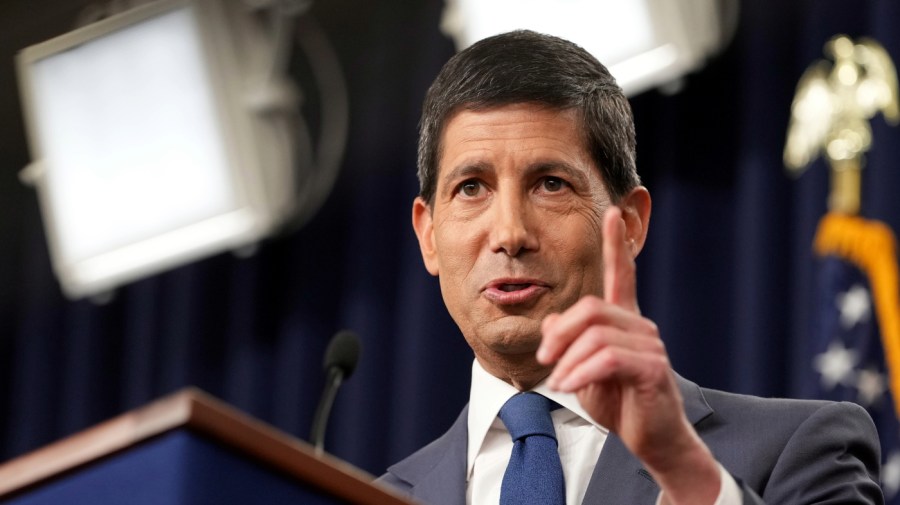
The Federal Reserve raised interest rates Wednesday for the first time in several years in the face of stubborn inflation.
The central bank's Federal Open Market Committee (FOMC), under Fed Chair Kevin Warsh, voted unanimously to increase the central bank's benchmark interest rate to a range of 3.75 percent to 4 percent. It marks the first time the Fed has hiked rates in more than three years, and the first time in nearly a year since the range touched 4 percent.
Warsh said after the decision that the rate hike will “support a timelier return” to the Fed’s 2 percent inflation target.
“I would be hard pressed to describe broad financial conditions as restrictive,” he told reporters. “This view was widely shared by the committee, so we removed a dose of accommodation.”
Looking ahead to the final two FOMC meetings of the year, a majority of committee officials project at least one rate hike. Twelve of 18 FOMC officials projected a single rate hike, according to a quarterly summary of economic projections the Fed released on Wednesday.
Four officials projected two hikes, while two predicted a pair of holds. Warsh, who has strayed away from issuing forward guidance as Fed chair, did not provide a projection for the Fed's last quarterly summary in June. He confirmed Wednesday that he again abstained from offering projections.
Markets widely expected officials to raise rates by a quarter point on Wednesday in an effort to tame inflation, which remains above the Fed’s 2 percent target amid the war with Iran.
But major stock indices still dipped after the decision, with the Dow Jones Industrial Average closing at a three-month low. The Nasdaq also fell by more than 130 points from Wednesday’s opening bell.
Traders were pricing in a nearly 93 percent chance that the FOMC would raise rates by a quarter point Wednesday morning, according to the CME Group’s FedWatch tool, which tracks bets placed on future Fed decisions.
Roughly 85 percent of economists Reuters surveyed over the weekend also predicted a quarter-point hike, a shift from the 70 percent of economists who predicted a hold before the Bureau of Labor Statistics reported annual inflation in August was 3.4 percent, as measured by the consumer price index (CPI).
But the move could rankle Warsh’s relationship with President Trump. The president has long pushed for rate cuts, dating to the tenure of former Fed Chair Jerome Powell — who still sits on the FOMC and voted Wednesday to hike rates.
Roughly four months before Powell’s eight-year tenure ended in May, the Justice Department launched a since-abandoned probe of the then-Fed chair over his handling of renovations to two of the central bank’s office buildings in Washington, D.C.
Powell blasted the probe as an effort by the department, on Trump’s behalf, to pressure the Fed on monetary policy. The former Fed chair has also stayed on as a Fed board member amid Fed Inspector General Michael Horowitz’s investigation into the renovations.
While Trump has given Warsh some room to maneuver in his first few meetings leading the central bank, he appears increasingly impatient for a cut.
“Interest Rates in the United States should be 1%, or less, because we are the Best Credit in the World — BY FAR," Trump posted on his Truth Social platform Wednesday, after the Fed rate announcement.
Warsh had hinted at voting to raise interest rates last month, saying the central bank would have “work to do” if inflation was not moving toward its 2 percent target.
“The responsibility for 65 months of sustained, elevated inflation sits squarely with the central bank. And that is where it belongs,” the Fed chair said at a summit in Jackson Hole, Wyo.
Advertisement
While speaking to reporters on Wednesday, Warsh dodged two questions on Trump, chuckling in response to the first.
But in speaking to the autonomy of the Fed from political influence, the chair said independence “is a two-way street.”
Warsh added, “We let people that do trade policy and fiscal policy stay in their lane too. That's how we can stand up here and call them the way we see them.”
The Fed has slowly but surely lowered rates over the past few years, as the economy has recovered from a bout of severe inflation.
Inflation surged after the COVID-19 pandemic, rising to a 40-year high of 9.1 percent in June 2022. The central bank began hiking rates in March 2022, although Powell faced criticism from experts for failing to move quickly enough to contain rising prices.
The Fed repeatedly raised rates throughout 2022 and 2023, before settling at a multiyear high of 5.25 percent to 5.5 percent. It kept rates there for more than a year as inflation eased, before starting a series of cuts in late 2024.
Roughly two years after reaching that four-decade high, inflation dipped to less than 3 percent and hovered between 2.3 percent and 3 percent for about 18 months.
But it spiked after the U.S. and Israel launched the war with Iran, a conflict that has resulted in a shock to the oil industry due to the Islamic Republic’s restrictions on shipping in the Strait of Hormuz.
Annual inflation hit a three-year high of 4.2 percent in May and has since fallen to 3.4 percent, according to the CPI.
The Fed’s preferred measure of inflation, the personal consumption expenditures (PCE) price index, also hit 4.1 percent in May and was 3.7 percent in July, according to data from the Bureau of Economic Analysis. The bureau will release PCE data for August on Sept. 30.
The Iran conflict, which hit the 200-day mark on Wednesday, also threatens to further increase inflation. The nonpartisan Congressional Budget Office reported Tuesday the war will increase its prior projection of annual inflation, as measured by the PCE, in the first quarter of 2027 by 0.5 percentage points.
FOMC officials slightly tweaked their outlook for inflation, based on the committee’s quarterly summary of projections. The median projected inflation rate for this year was 3.7 percent, up from 3.6 percent in June.
Officials also do not project inflation to dip to 2 percent until 2029, after projecting three months ago it will reach the Fed’s target by 2028.
Loretta Mester, a former Cleveland Fed president, said there was a “cogent case” for a rate hike, adding incoming inflation data “are not convincing that underlying inflation is on a downward path" to 2 percent.
Warsh was also resolute in saying the committee will deliver “price stability,” laying out the stakes if inflation remains above target.
“The least well off are the ones who have the most to gain from stable prices,” he said, specifically naming those who do not own a home, have a 401(k) plan and are living paycheck-to-paycheck.
“In stable prices, an environment where inflation is running consistent with our 2 percent objective offers good news because that way, when they get their wages, they can put their head above water and deliver real take-home pay increases,” Warsh added.
at 5 p.m. EDT
Copyright 2026 Nexstar Media, Inc. All rights reserved. This material may not be published, broadcast, rewritten, or redistributed.For the latest news, weather, sports, and streaming video, head to The Hill.
Source: “AOL Money”
